

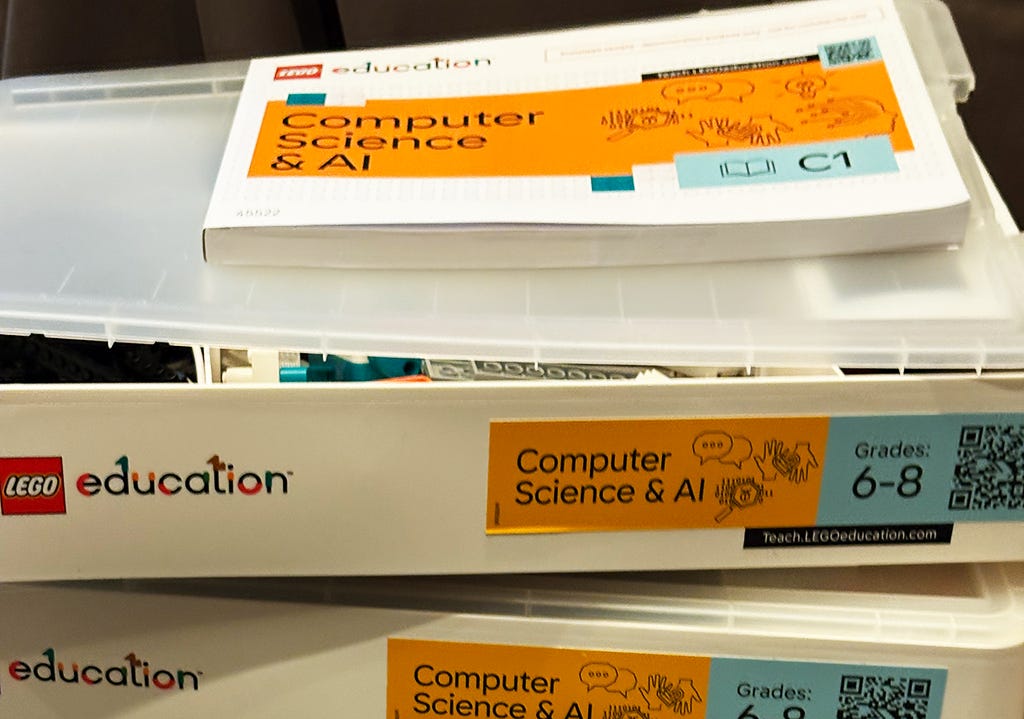
Many companies are working to help prepare kids for the near future when AI will be increasingly capable and a core part of all of our lives. LEGO education made some recent announcements that illustrate the direction we are all headed.
In January, LEGO announced that they will retire the popular Spike Prime robotics kits. They will be replaced a new set called “Computer Science & AI”, which will ship in April. Then, in June, LEGO will stop selling Spike Prime anymore. FIRST Lego League is also changing in response, introducing a new Future Edition that will phase in starting next year. These rapid changes are causing a lot of anxiety among schools and robotics teams that are unsure how to adopt the new robotics system.
Andrew Sliwinski, the head of product experience for LEGO education, said that the new kits are “everything that a teacher would need to teach all the foundational principles of computer science and AI.” While most online discussion has centered on the programming & robotics capabilities, I am curious: do these really teach all the foundational principles of AI?
Last week, I had a chance to play with the new kits at the IDEACon conference. In the end, LEGO has built a less capable robotics kit that just flirts with AI models, but the machine learning component is quite limited. There are better ways to teach kids about machine learning, without the cost of a new LEGO kit.
Image classification misses most of what we consider “AI”
The vast majority of students today interact with artificial intelligence in some form on a regular basis. They see the growing power of LLMs. And middle schoolers today will be graduating college in the mid-2030s. By that time, the exponential increase in the capabilities of artificial intelligence systems will have far surpassed humans in many dimensions. Students should learn about these AI systems while still in school to help prepare them for the rapidly transforming world.
There are two approaches to teaching about AI. One way is to show how to use tools like ChatGPT, Gemini or Claude for coding. Many schools teach kids some guidelines about how to watch for hallucinations, spot biases, and not to rely too much on chatbots.
But students should also have an opportunity to go deeper - to learn fundamentals of how these systems work. And there are plenty of incredible products available that help them do that.
While most computer science AI courses are at the high school or college level, there are a few that offer middle schoolers and younger the chance to train models, run inference, and evaluate results. For example, CodeHS offers a free middle school course on AI that shows kids how to train models to classify and generate music using TeachableMachine from Google. TeachableMachine makes it easy for students to gather data, train a model, and then use that model to make their own applications.
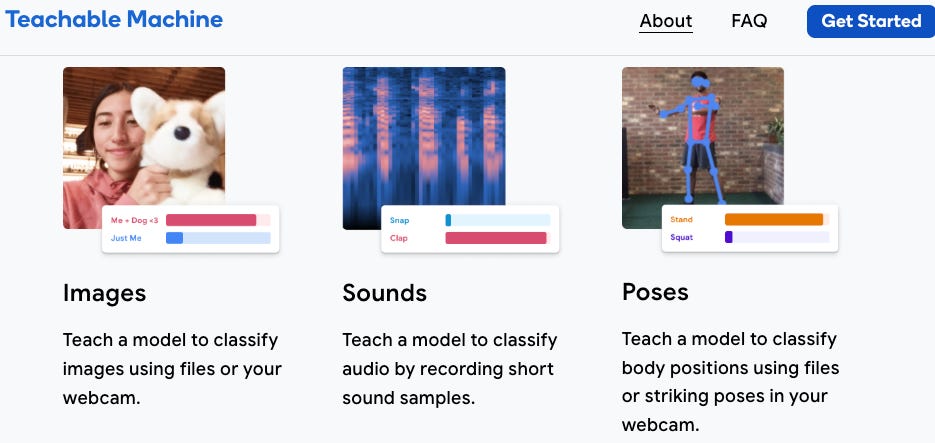
The new LEGO systems focuses narrowly on only one branch of AI: human pose estimation. Students can use the computer’s webcam to detect skeleton points on their body - such as elbow, wrist, nose, and legs. They can wire those up to coding blocks to take action based on the position of different body parts, or train a model to detect different poses.
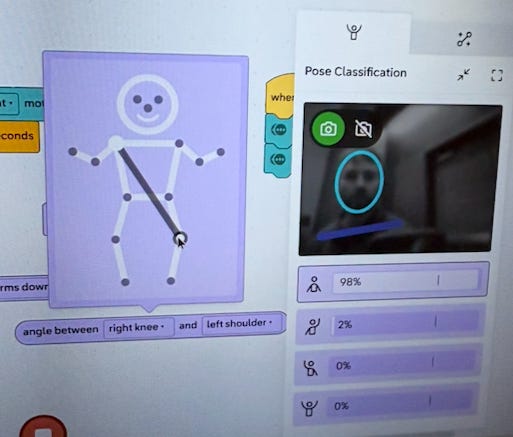
The built-in model can detect whether the webcam sees a person, whether your arms are up or down, and it can measure the angles between different points on your body skeleton.
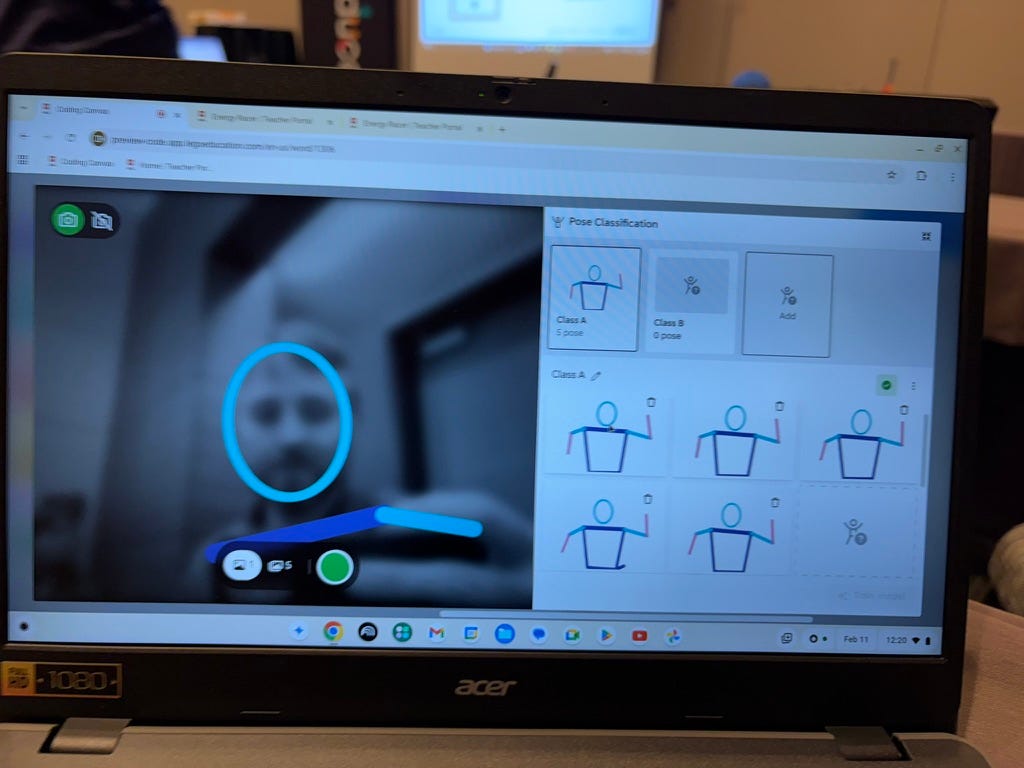
Once students get a hang of inference on the pre-built models, they can move on to more advanced concept of training their own model. To do this, you can take photos of your body in different positions. These serve as training data for a classifier. Here, you can see my attempt to train a class of poses:
The machine learning models can be wired to LEGO models. For instance, in their demo lesson, LEGO shows off a student controlling the arms of a robot model by waving their own hands:
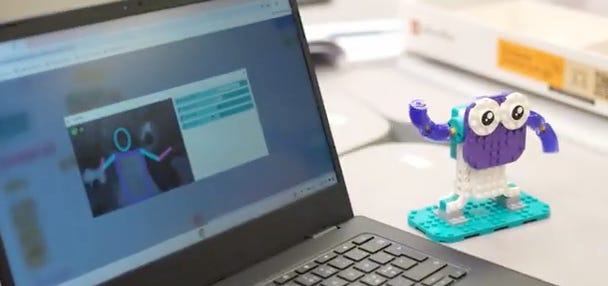
This is pretty cool! In our training session, one of the participants figured out how to control a robot minifig with her nose. When she lifted her chin, the robot jumped in the air. There are some neat opportunities to help students see how they can control robots using their own bodies.
This is LEGO at its best - brings computer science concepts into the real world. Students can use pose detection to control real world LEGO models, and they can feed in pictures of themselves to direct new poses that aren’t in the pre-built model.
Limited by design
Unfortunately, once you get the basics of the pose classification - that’s about it. It’s a nice demo, and maybe a great lesson for one or two classes - but I don’t think it goes much deeper than that.
We can see how limited it is by looking at the programming canvas. See below the full set of AI blocks that LEGO is releasing in April. Students can detect a person or pose, and leverage the specific angles between body parts.
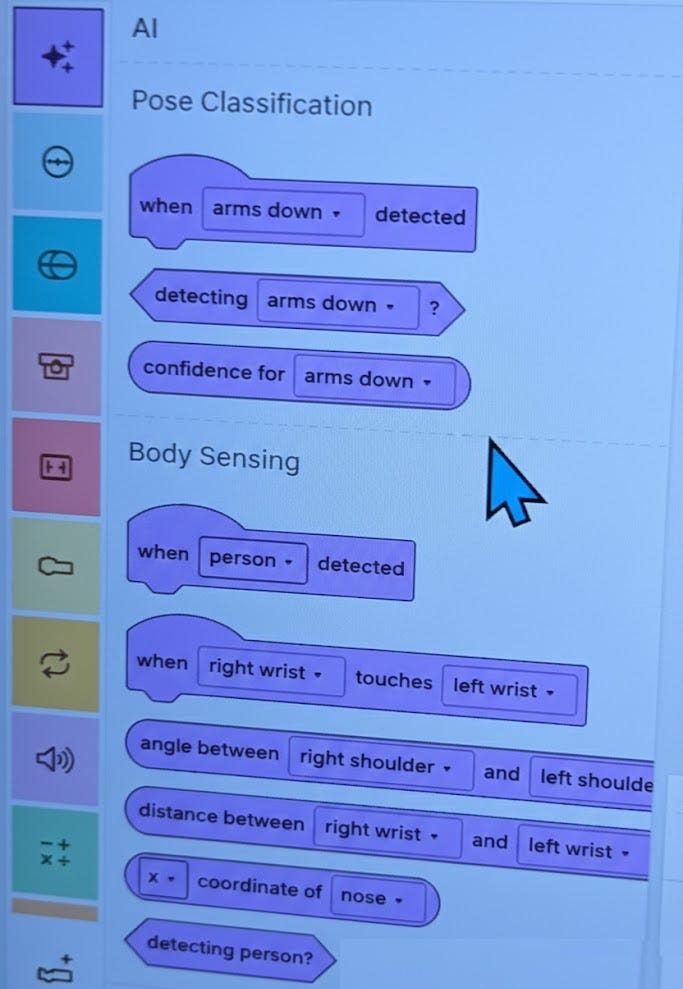
According to LEGO, their pose detection model is based on the older technology called BlazePose. This model was published six years ago in 2020 - years before ChatGPT or any of the more recent AI models. BlazePose runs entirely in the browser, on consumer hardware (no GPU), using only local data. UPDATE: After I published this article, I re-checked the Lego website, and they’ve updated it to say that they use the model MoveNet rather than BlazePose. MoveNet was published in 2021. It is faster and smaller but otherwise largely the same as BlazePose.
By using only local models, LEGO is trading privacy for power. Andrew Sliwinski from LEGO says this explicitly: “We are bringing AI and education in a hands-on way that LEGO does. But we’re doing it rooted in privacy and trust. … Everything we do runs locally on the kids’ device. There are no student accounts and no data is ever transmitted to a third party.”
When I first saw that LEGO was introducing image classification, I thought that meant the robot would be able to see the world around it. How cool would it be for the robot to react to what it could see? But no - there is no camera on the robot - instead, the images come from the computer’s webcam. A computer needs to be always connected and in range in order to use any of the new programming tools.
When I think of AI & Computer Science in 2026, I think of LLM-assisted coding, or image generation, voice interactivity, or autonomous AI agents. But the issue with all of those is that the newer forms of powerful AI are inherently risky. Lego has chosen to play it safe - keeping all data local on the device means that they can’t leverage modern models that rely on GPUs.
It’s hard to claim that the system covers all the foundations of modern AI without being able to leverage any of the recent models built in the current decade. It seems like the “AI” label is added by marketing, but is more of an afterthought in the product itself. Educators who want to teach AI would do better to use Teachable Machine or other online tools.
LEGO kits are built for classroom teaching in schools
Compared to Spike Prime, the new kits have several improvements that help them fit well within an elementary classroom. First and foremost, they are designed for group collaboration. Second, all connection happens wirelessly from computers - meaning far less cord management. And third, the offer a suite of pre-built lessons with a teacher dashboard, group collaboration built in, and simpler, streamlined sets designed to be re-used by multiple classes in a single day.
Group collaboration built in
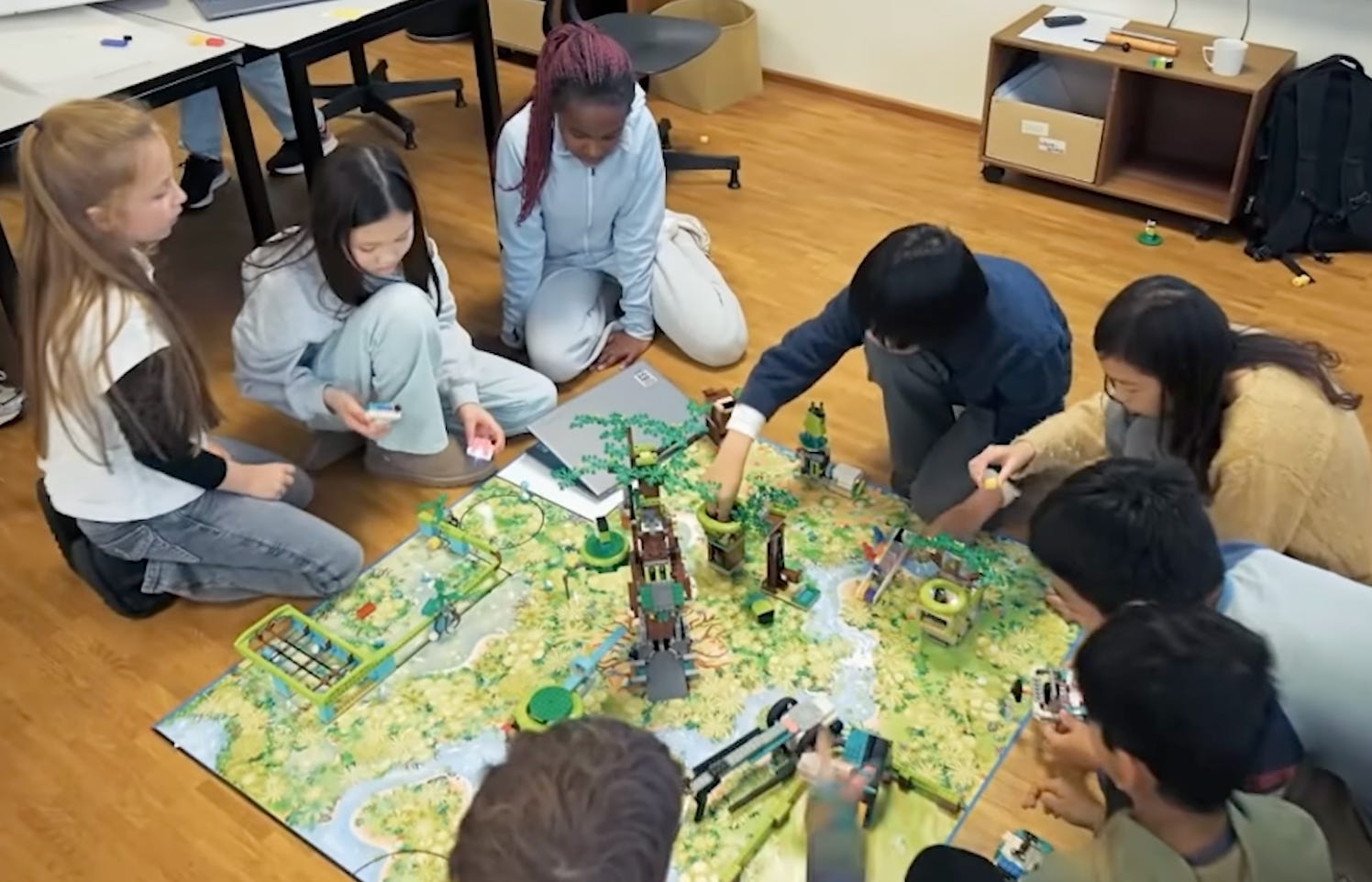
The new lessons are built from the ground up to support teams, rather than individuals. Today, because most LEGO kits require that pieces be put together in order, most LEGO assembly works best alone or with a partner. This can make it hard when you have a large group of kids working together.
But the new lessons are designed to allow up to four people to build at the same time. Each page of instructions has very small steps for each of the team members.
The trainer in my session said there are “no bossy builders, no silent sitters”. The lessons are built for teams. In our demo lessons, this mostly worked - each participant waited for the others before moving on.
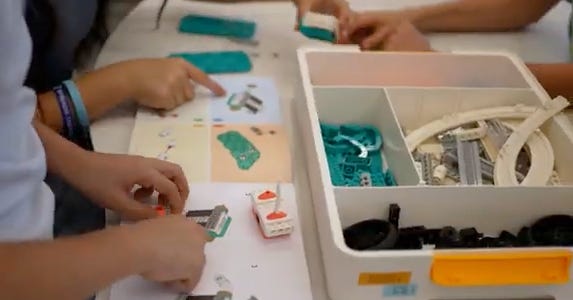
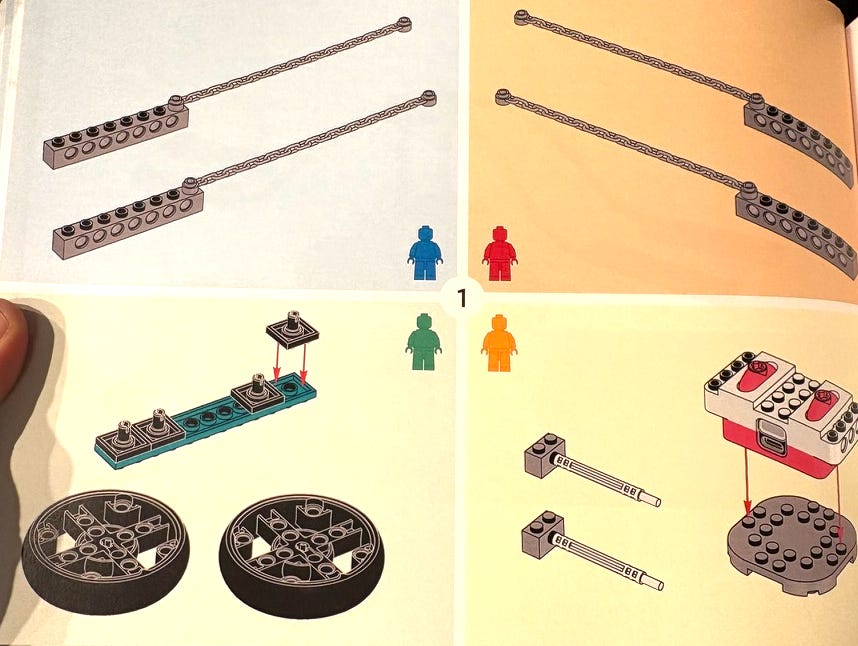
LEGO trainers reinforced that the new lessons are designed for groups to sit at a table rather than staring at a laptop.
Wireless connections means fewer cords
The new system connects components entirely by Bluetooth. Components connect to each other, in screen free mode, or if there’s a laptop involved, then they can connect to the laptop the same way - by flashing new Color Cards.
Having no wires may mean a simpler classroom experience, when everything works right. However, I anticipate a few potential issues. Each component still needs to connect to a controlling laptop via Bluetooth. Instead of being either connected or not, as with Spike Prime, students will now need to worry about whether each of the motors has its own connection. Also, each component needs to be charged separately. Since each kit has up to four items that need charging, I expect that there will be a lot more “my battery is low” issues in classrooms that forget to plug everything in.
Pre-built lessons with teacher dashboard
Spike Prime today has a few small lessons, but I have found they aren’t that easy to implement. The Spike robot can take a while to assemble, and students are reluctant to break it down just in a single class period. There’s quite a bit of legwork just getting to the lesson.
The new teacher portal has built-in slides, including recommended build time for each small step. And students can join a lesson with a code - a much more standard way to link lessons. The teachers at the conference sessions I went to were excited by the ability to start teaching these with less prep time.
Future is murky for robotics programs
Change is hard. It’s especially hard when the new kit isn’t here yet and everything seems to be changing.
So the new AI & CS kits are likely good bets for classrooms - but how will they fare for FIRST Lego League? Here, I’m a bit more ambivalent - let’s wait and see.
FLL has announced a “Future Edition” that will run side-by-side with the current rules for the next two years. The FLL Share and Learn Facebook group has been doing a great job of tracking the differences, and Creator Academy Australia has an excellent breakdown as well. The key differences are:
Robots will no longer be autonomous - instead, students will use a laptop for control at all times (or at least most of the time).
Teams are maxed at 8 kids instead of 10 (although in truth, FLL teams get quite unwieldy over 7 anyway, so this is likely good guidance). Teams also support multiple different roles, not just “technician”, which supports the core values of inclusion and teamwork.
The new board is half the size - I think this will make it much easier to fit practice into standard classroom spaces.
The new kits cost a little more, but not crazy more than previous sets. At its launch, the EV3 cost $492 (in 2025 dollars), and Spike Prime cost $414. The new CS & AI middle school kit will cost $429 for the 3rd-5th grade set, or $529 for the middle school version.
Seems like the new kit was built first for classrooms, and then FIRST is trying to shoehorn it in to a new system to allow FLL to keep going. My advice: I think robotics teams should sit it out the next year. In Illinois, we plan to continue competing in the Founders Edition, at least until we know more about the program. I think that Spike Prime will continue to have a strong role to play in teaching robotics, and I hope that the secondary market stays strong for some time.
Many schools are worried about the price. If you just plunked down thousands of dollars for a class set of Spike Primes, then it can feel a bit like a bait and switch to have to upgrade right away for new sets as well. In that case, for schools that already have a set of kits, I would recommend waiting to see how the real life usage evolves in the months ahead.
On balance, I think that LEGO has made a good kit for classrooms to use to teach basic coding and building skills through play. Kids will likely have fun. The AI offerings are quite limited, and there are better options such as Teachable Machines, but it’s still a good first effort. There’s no reason they couldn’t expand those offerings in the future as well - perhaps to add a camera or other features.
LEGO has a deep history of prioritizing kids, hands-on learning and fun. Their previous upgrades were met with skepticism at the time but proved to be great bets in the long run. I am optimistic that the teams at LEGO and FIRST will experiment, listen to feedback, and iterate towards an incredible product that will usher in the next generation of engineers - even if it’s not yet quite the right fit for everyone.